
Commerce Transformation
Shopify Markets vs Expansion Stores: How to Structure Multi-Region and Multi-Brand Commerce
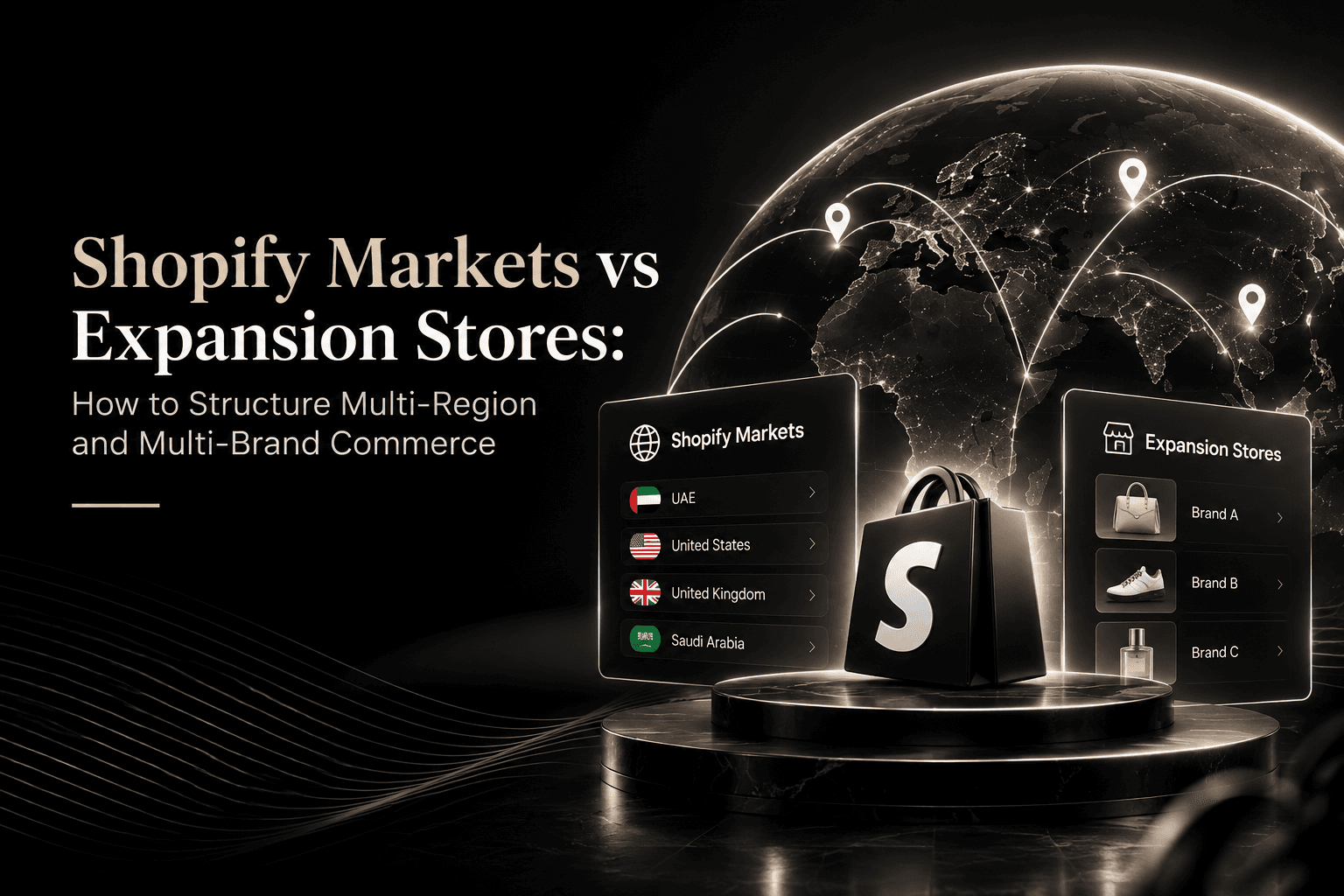
For most brands, the choice between Shopify Markets vs expansion stores comes down to one question: how independent do your regions actually need to be?
Use Shopify Markets when multiple countries can share the same commerce core, while localising pricing, currencies, products, languages, domains and selected storefront content. Use Shopify Plus expansion stores when a region needs a genuinely independent store, with separate data, configuration, integrations, merchandising or operational ownership.
For multi-brand businesses, there is another wrinkle: Shopify’s standard expansion-store model is designed primarily for extensions of the same brand, not unrelated brands.
That distinction matters. Choosing too many separate stores creates duplicated technology and operational overhead. Trying to force highly independent markets into one store creates a different problem: regional teams start fighting the platform instead of using it.
The right architecture is rarely about how many countries you sell into. It is about how differently those countries need to operate.
Shopify Markets vs expansion stores: what is the actual difference?
Shopify Markets lets one Shopify store serve multiple markets. Shopify Plus expansion stores create additional independent Shopify stores within a Plus organisation. Markets maximise centralisation. Expansion stores maximise operational separation.
With Markets, Shopify can vary product availability, pricing, currency, language, domains, tax presentation and selected storefront content by market while keeping customers, orders, inventory structures, apps and the underlying store together. Shopify has expanded Markets significantly, including catalogs, submarkets and, on Plus, support for multiple business entities.
An expansion store is different. Shopify describes each one as an independently operating store with its own data, settings and configurations, even though organisation-level billing and user management can remain centralised. A standard Shopify Plus contract currently supports one main store plus nine expansion stores at no additional store cost.
Decision area | Shopify Markets | Shopify Plus expansion stores |
Commerce structure | One Shopify store serving multiple markets | Separate Shopify stores |
Best fit | Same brand and broadly shared operating model | Regions needing substantial operational independence |
Catalogs and pricing | Market-specific catalogs, availability and pricing | Completely independent product and pricing setup |
Currency | Local currencies and market-level configuration | Currency and payment setup controlled independently per store |
Content | Market-specific content possible, within Shopify's Markets framework | Fully independent themes, content and storefronts |
Domains | Subfolders, subdomains or separate domains | Independent domain strategy per store |
Apps | One underlying store and app environment | Apps and configurations may need to be deployed store by store |
Inventory | Easier to maintain one commerce inventory model | Cross-store inventory normally needs ERP, OMS or middleware coordination |
Teams | Centralised administration; some permissions remain store-wide | Greater store-level operating separation |
SEO | Strong option for consolidated international SEO | Greater independence, but more domains and SEO estates to manage |
Multi-brand use | Can support differentiated customer experiences, but still one store architecture | Standard included expansion stores have same-brand eligibility rules |
Operational overhead | Lower | Higher |
The mistake is treating the right-hand column as inherently “more enterprise”. Complexity is not sophistication. A separate store is useful only when the business difference justifies the additional operational surface area.
When should you use Shopify Markets?
Choose Shopify Markets when the commercial differences between countries can be expressed as rules and localisations rather than completely separate businesses. If your UAE, Saudi, UK and US operations share the same core products, technology, data model and brand, Markets will usually provide the cleaner starting architecture.
Modern Shopify Markets goes much further than simply displaying another currency.
A merchant can define regional markets and submarkets, control which products and prices apply through catalogs, configure currencies, assign domains and languages, change tax and duty presentation, and apply market-specific storefront customisations. Shopify Plus can also assign different business entities to markets when multiple eligible Shopify Payments accounts have been configured.
That last point is particularly important because an old rule of thumb was that “multiple legal entities always require multiple Shopify stores”. That is no longer universally true.
Markets works well when localisation is substantial but the commerce core is shared
Consider a fashion business selling in the UAE, Saudi Arabia and the UK.
The brand might need AED, SAR and GBP pricing. Saudi Arabia might require a different product assortment. UAE campaigns might feature different collections. Arabic content could sit alongside English. Each country could have its own domain structure and delivery proposition.
None of that automatically requires three stores.
Shopify Markets can use catalogs to determine which products and prices customers receive, while domain and language customisations can create region-specific URLs. Shopify also supports subfolders, subdomains and country domains. When configured correctly, Shopify automatically handles technical international SEO elements including hreflang tags, canonical URLs and international sitemap entries.
For brands trying to preserve the authority of an established .com, subfolders are particularly useful because Shopify notes that they share authority with the primary domain. Separate country domains can still be used where the brand has a deliberate local-domain strategy.
But Markets is not unlimited localisation
There are boundaries.
Market-specific theme customisation requires the Advanced plan or higher. Shopify still uses one published theme, and global theme settings such as colours and typography cannot vary by market. Liquid templates cannot be independently changed for each market either.
Team structure can become another constraint. Shopify states that staff permissions cannot currently be restricted by individual market. Someone who can access orders at store level can potentially access orders across that store’s markets.
That may be fine for a centrally managed DTC business. It becomes more relevant when autonomous regional subsidiaries, franchise operators or distribution partners require hard operational boundaries.
When do Shopify Plus expansion stores make more sense?
Use Shopify Plus expansion stores when the region requires its own operating environment, rather than merely a localised customer experience. Separate regional teams, significantly different storefronts, independent app stacks, complex integrations, distinct product models or hard data separation are stronger reasons for multiple stores.
Every expansion store has separate data, settings and configuration. That gives teams substantially more freedom, but it also means more systems to govern.
A KSA storefront could run a different theme architecture, merchandising model and integration logic from the UAE store. The regional team could manage its release calendar without every decision affecting the global storefront.
That independence becomes valuable when your differences extend deep into operations.
For example, imagine the Saudi business has its own warehouse, ERP workflows, customer-service team, product releases, local applications and fulfilment rules, while the UAE business operates from a different inventory pool and regional technology stack.
You could spend considerable time modelling exceptions inside a single store.
Or you could acknowledge that the businesses are operationally different enough to warrant separate stores.
The trade-off is that multiple storefronts introduce duplication. Product changes, applications, theme deployments, analytics configuration, integrations and QA processes may all have to be repeated or centrally orchestrated.
If multiple stores sell from overlapping inventory, the commerce architecture also needs a reliable source of truth. An ERP, OMS or inventory layer often becomes essential rather than optional. Autumn’s guide to Shopify and ERP integration in the Middle East covers this wider systems question, while its guide to multichannel inventory management explores the inventory side in more depth.
Multi-region and multi-brand commerce are not the same problem
This is where many enterprise architecture discussions go wrong.
A business with one brand across ten countries and a business with ten brands in one country both have “multiple storefront requirements”. Their governance needs can be completely different.
Shopify’s current eligibility rules state that standard Plus expansion stores must be extensions of the main brand, use the same brand name and branding, and carry the same types of goods or services. Shopify specifically directs businesses whose stores represent different brands to discuss multi-brand agreement options with Shopify Plus Support.
So if you operate multi-brand ecommerce websites, do not assume that the nine included Shopify Plus expansion stores can simply become nine unrelated brands.
The commercial agreement matters as much as the technical architecture.
From a technology perspective, separate brands often justify separate stores because each may have its own visual identity, product taxonomy, CRM strategy, customer base, merchandising team and growth roadmap. The opportunity is then to centralise the layers that should be shared, such as ERP, PIM, OMS, analytics and middleware, without forcing the storefronts themselves into an artificial single-store model.
That is a more useful definition of a multi store ecommerce platform: not merely several websites, but a governed commerce ecosystem in which shared and independent capabilities have been chosen deliberately.
What happened to Shopify Markets Pro?
Shopify Markets Pro was renamed Managed Markets in 2024. It should not be treated as a third alternative to Markets or expansion stores. Managed Markets is an international selling service layered onto Markets, with Global-e acting as merchant of record for eligible cross-border orders.
Under Managed Markets, Global-e handles areas including duties, tax remittance, customs documentation and aspects of international shipping as merchant of record. Shopify Markets without Managed Markets leaves the merchant responsible for those obligations.
This matters for keyword research because merchants still frequently search for Shopify Markets Pro, even though the current product name is Managed Markets. Shopify officially changed the name in June 2024.
There is also an important availability limitation. As of September 2026, Shopify states that Managed Markets is available to businesses based in the continental United States and certain stores in Canada and the UK. It is therefore not a general cross-border compliance solution available to every UAE- or Saudi-headquartered merchant.
How should UAE and GCC brands think about the decision?
For GCC commerce, start with the operating model rather than assuming every country needs its own store. UAE and Saudi customers may require different languages, pricing, assortments, fulfilment promises and campaigns, but Markets can handle many of those differences. Move to separate stores when the underlying operations, entities or technology genuinely diverge.
The equation has also changed for UAE merchants.
Shopify Payments is now supported for eligible UAE businesses, with AED payouts available. This makes more of Shopify’s native international currency and Markets capabilities usable for UAE-based businesses than in earlier platform architectures.
Shopify’s current supported-country list includes the UAE but does not list Saudi Arabia, so the merchant’s home entity and payment architecture still need to be assessed carefully when designing a Saudi-led or GCC-wide storefront.
For UAE cross-border ecommerce, the architecture should therefore consider more than translation and currencies. Teams need to map where inventory is owned, which legal entity sells the goods, where returns go, how regional payments settle, who manages tax and customs obligations, what Arabic localisation is required, and whether Saudi Arabia is simply another customer market or a self-contained operating business.
Brands evaluating KSA specifically can go deeper with Autumn’s Saudi Arabia ecommerce market-entry playbook.
A six-step framework for choosing your Shopify architecture
Instead of beginning with “How many stores should we build?”, work through these decisions in order:
Map commercial differences. Document products, price lists, promotions, currencies, languages, customer propositions and checkout requirements by country. If most differences can be represented through Markets settings and catalogs, keep a single store on the table.
Map operational differences. Compare warehouses, inventory ownership, returns, customer service, regional teams, ERP processes, payment providers and fulfilment workflows. Operational divergence is a stronger reason for separate stores than front-end localisation alone.
Map legal and financial ownership. Identify the selling entity for each country, settlement requirements and tax responsibilities. Remember that Shopify Plus can now assign business entities to Markets, so multiple entities do not automatically force multiple storefronts. Have legal and tax advisers validate the final structure.
Test the storefront gap. Ask whether regional requirements need different content or genuinely different storefront technology. Market-specific sections and promotions can fit Markets. Different theme code, applications or end-to-end journeys may justify independent stores.
Calculate the operating cost of separation. Include app licences, development, releases, QA, analytics, catalog maintenance, integrations, translations and support. The cost of another Shopify store is not just its platform fee.
Design for the next three years. A structure that works for two markets may become painful at twelve. Conversely, building twelve independent stores before demand exists creates expensive infrastructure ahead of revenue. Choose the smallest architecture that can support the operating model you are realistically building.
The strongest architecture is often hybrid
Enterprise commerce does not have to choose one model globally.
A brand might run the UAE, Kuwait, Qatar, Bahrain and Oman through one Shopify store using Markets because products and operations are closely aligned. Saudi Arabia might later move into an expansion store if it develops its own inventory organisation, entity, fulfilment model and regional ecommerce team.
Europe could sit in another store.
A wholesale business could have its own B2B environment.
Separate brands might operate as separate stores under the appropriate Shopify commercial arrangement while feeding a common ERP, PIM or data platform.
This hybrid approach avoids two extremes: one enormous store filled with exceptions, or a collection of disconnected regional stores that recreate the same work repeatedly.
The architectural goal should be controlled independence.
Share what creates leverage. Separate what creates friction when shared.
What should enterprise teams decide before implementation?
Before development starts, the architecture should be clear on market ownership, entities, product and pricing governance, inventory sources, order routing, payments, currencies, domains, languages, regional SEO, returns, customer data, analytics, integrations, release management and access controls.
Pay particular attention to the systems behind Shopify.
A regional storefront can look perfectly local while the operation underneath remains fragmented. That is when teams start seeing stock mismatches, duplicated catalog work, manual reconciliation, slow launches and inconsistent reporting.
Commerce architecture should remove those problems rather than move them from the frontend into the backend.
Autumn is an AI-first commerce transformation company. It helps growth-stage and enterprise brands modernise commerce operations, improve revenue performance, build scalable commerce ecosystems and expand across GCC and global markets. For businesses assessing Markets, expansion stores or a hybrid model, the useful starting point is not a Shopify feature comparison. It is a map of how the business needs to operate at scale.
FAQs about Shopify Markets vs expansion stores
What is the main difference between Shopify Markets and expansion stores?
Shopify Markets serves multiple countries, customer groups or regions from one underlying Shopify store. It can vary elements such as products, pricing, currencies, languages, domains and selected theme content. Expansion stores are separate Shopify stores inside a Plus organisation, with independent data, settings and configurations. Markets therefore prioritises centralisation, while expansion stores provide greater operational separation. The right option depends on how differently each region needs to operate, not simply how many countries you sell in.
How many expansion stores do you get with Shopify Plus?
Shopify currently states that a standard Shopify Plus organisation can have up to ten stores on its contract without an additional store charge: one main store and nine expansion stores. Staging stores do not count towards that limit. Additional stores can be discussed with Shopify Support. Importantly, the included expansion stores are subject to eligibility rules and generally need to be extensions of the same main brand rather than unrelated businesses.
Can Shopify Markets support different legal entities?
Yes, on Shopify Plus, Markets can support multiple business entities when the merchant has appropriate Shopify Payments accounts for those entities. A business entity can then be assigned to a particular market so transactions are processed through the relevant entity. This makes single-store architecture viable for some organisations that previously would have required multiple stores. The arrangement still needs to match local legal, tax and payment requirements, so entity architecture should be validated before implementation.
Should every country have its own Shopify expansion store?
Usually not. A country deserves a separate store when it behaves like a separate operating business, not merely because customers use another language or currency. Markets can already support substantial regional localisation. A separate store becomes more useful when a country has materially different integrations, regional teams, warehouses, merchandising, applications, operational processes or storefront technology. Creating a store per country without those requirements can multiply catalog, app, QA and integration work unnecessarily.
Can different brands use Shopify Plus expansion stores?
Not automatically under Shopify’s standard expansion-store eligibility. Shopify says included expansion stores must be extensions of the main brand, with the same brand identity and the same types of goods or services. Organisations running genuinely different brands should discuss Shopify’s multi-brand agreement options with Shopify Plus Support. Technically, separate stores may still be the right architecture for a multi-brand group, but the contractual structure needs to be established before treating those stores as standard expansion stores.
Is Shopify Markets Pro the same as Shopify Markets?
No. Markets Pro was renamed Managed Markets in 2024. Shopify Markets is the platform capability used to configure different market experiences. Managed Markets is an additional international-selling service powered with Global-e as merchant of record, handling areas such as duties, tax remittance and customs for eligible orders. Managed Markets also has geographic eligibility requirements, so it should not be assumed to be available to every international merchant.
Can Shopify Markets handle UAE and Saudi Arabia from one store?
Potentially, yes. A single store can use Markets to differentiate products, pricing, currencies, domains, languages and customer experiences between the UAE and Saudi Arabia. Whether it is the right architecture depends on the merchant’s payment setup, entities, inventory ownership, fulfilment and regional operating model. If Saudi operations become substantially independent, a separate store may eventually be cleaner. The decision should follow business and systems architecture rather than a country-by-country rule.

Written by
Anand Vardhan
Founder
APAC's Leading Shopify Partner, now building across the GCC | AI-Led Commerce for DTC & Retail Brands | 1,000+ Builds

Free Consultation
Schedule a Strategy Briefing
Let’s create something amazing together! Reach out we'd love to hear about your project and ideas.
Explore other Categories
Commerce Transformation
Shopify Markets vs Expansion Stores: How to Structure Multi-Region and Multi-Brand Commerce
For most brands, the choice between Shopify Markets vs expansion stores comes down to one question: how independent do your regions actually need to be?
Use Shopify Markets when multiple countries can share the same commerce core, while localising pricing, currencies, products, languages, domains and selected storefront content. Use Shopify Plus expansion stores when a region needs a genuinely independent store, with separate data, configuration, integrations, merchandising or operational ownership.
For multi-brand businesses, there is another wrinkle: Shopify’s standard expansion-store model is designed primarily for extensions of the same brand, not unrelated brands.
That distinction matters. Choosing too many separate stores creates duplicated technology and operational overhead. Trying to force highly independent markets into one store creates a different problem: regional teams start fighting the platform instead of using it.
The right architecture is rarely about how many countries you sell into. It is about how differently those countries need to operate.
Shopify Markets vs expansion stores: what is the actual difference?
Shopify Markets lets one Shopify store serve multiple markets. Shopify Plus expansion stores create additional independent Shopify stores within a Plus organisation. Markets maximise centralisation. Expansion stores maximise operational separation.
With Markets, Shopify can vary product availability, pricing, currency, language, domains, tax presentation and selected storefront content by market while keeping customers, orders, inventory structures, apps and the underlying store together. Shopify has expanded Markets significantly, including catalogs, submarkets and, on Plus, support for multiple business entities.
An expansion store is different. Shopify describes each one as an independently operating store with its own data, settings and configurations, even though organisation-level billing and user management can remain centralised. A standard Shopify Plus contract currently supports one main store plus nine expansion stores at no additional store cost.
Decision area | Shopify Markets | Shopify Plus expansion stores |
Commerce structure | One Shopify store serving multiple markets | Separate Shopify stores |
Best fit | Same brand and broadly shared operating model | Regions needing substantial operational independence |
Catalogs and pricing | Market-specific catalogs, availability and pricing | Completely independent product and pricing setup |
Currency | Local currencies and market-level configuration | Currency and payment setup controlled independently per store |
Content | Market-specific content possible, within Shopify's Markets framework | Fully independent themes, content and storefronts |
Domains | Subfolders, subdomains or separate domains | Independent domain strategy per store |
Apps | One underlying store and app environment | Apps and configurations may need to be deployed store by store |
Inventory | Easier to maintain one commerce inventory model | Cross-store inventory normally needs ERP, OMS or middleware coordination |
Teams | Centralised administration; some permissions remain store-wide | Greater store-level operating separation |
SEO | Strong option for consolidated international SEO | Greater independence, but more domains and SEO estates to manage |
Multi-brand use | Can support differentiated customer experiences, but still one store architecture | Standard included expansion stores have same-brand eligibility rules |
Operational overhead | Lower | Higher |
The mistake is treating the right-hand column as inherently “more enterprise”. Complexity is not sophistication. A separate store is useful only when the business difference justifies the additional operational surface area.
When should you use Shopify Markets?
Choose Shopify Markets when the commercial differences between countries can be expressed as rules and localisations rather than completely separate businesses. If your UAE, Saudi, UK and US operations share the same core products, technology, data model and brand, Markets will usually provide the cleaner starting architecture.
Modern Shopify Markets goes much further than simply displaying another currency.
A merchant can define regional markets and submarkets, control which products and prices apply through catalogs, configure currencies, assign domains and languages, change tax and duty presentation, and apply market-specific storefront customisations. Shopify Plus can also assign different business entities to markets when multiple eligible Shopify Payments accounts have been configured.
That last point is particularly important because an old rule of thumb was that “multiple legal entities always require multiple Shopify stores”. That is no longer universally true.
Markets works well when localisation is substantial but the commerce core is shared
Consider a fashion business selling in the UAE, Saudi Arabia and the UK.
The brand might need AED, SAR and GBP pricing. Saudi Arabia might require a different product assortment. UAE campaigns might feature different collections. Arabic content could sit alongside English. Each country could have its own domain structure and delivery proposition.
None of that automatically requires three stores.
Shopify Markets can use catalogs to determine which products and prices customers receive, while domain and language customisations can create region-specific URLs. Shopify also supports subfolders, subdomains and country domains. When configured correctly, Shopify automatically handles technical international SEO elements including hreflang tags, canonical URLs and international sitemap entries.
For brands trying to preserve the authority of an established .com, subfolders are particularly useful because Shopify notes that they share authority with the primary domain. Separate country domains can still be used where the brand has a deliberate local-domain strategy.
But Markets is not unlimited localisation
There are boundaries.
Market-specific theme customisation requires the Advanced plan or higher. Shopify still uses one published theme, and global theme settings such as colours and typography cannot vary by market. Liquid templates cannot be independently changed for each market either.
Team structure can become another constraint. Shopify states that staff permissions cannot currently be restricted by individual market. Someone who can access orders at store level can potentially access orders across that store’s markets.
That may be fine for a centrally managed DTC business. It becomes more relevant when autonomous regional subsidiaries, franchise operators or distribution partners require hard operational boundaries.
When do Shopify Plus expansion stores make more sense?
Use Shopify Plus expansion stores when the region requires its own operating environment, rather than merely a localised customer experience. Separate regional teams, significantly different storefronts, independent app stacks, complex integrations, distinct product models or hard data separation are stronger reasons for multiple stores.
Every expansion store has separate data, settings and configuration. That gives teams substantially more freedom, but it also means more systems to govern.
A KSA storefront could run a different theme architecture, merchandising model and integration logic from the UAE store. The regional team could manage its release calendar without every decision affecting the global storefront.
That independence becomes valuable when your differences extend deep into operations.
For example, imagine the Saudi business has its own warehouse, ERP workflows, customer-service team, product releases, local applications and fulfilment rules, while the UAE business operates from a different inventory pool and regional technology stack.
You could spend considerable time modelling exceptions inside a single store.
Or you could acknowledge that the businesses are operationally different enough to warrant separate stores.
The trade-off is that multiple storefronts introduce duplication. Product changes, applications, theme deployments, analytics configuration, integrations and QA processes may all have to be repeated or centrally orchestrated.
If multiple stores sell from overlapping inventory, the commerce architecture also needs a reliable source of truth. An ERP, OMS or inventory layer often becomes essential rather than optional. Autumn’s guide to Shopify and ERP integration in the Middle East covers this wider systems question, while its guide to multichannel inventory management explores the inventory side in more depth.
Multi-region and multi-brand commerce are not the same problem
This is where many enterprise architecture discussions go wrong.
A business with one brand across ten countries and a business with ten brands in one country both have “multiple storefront requirements”. Their governance needs can be completely different.
Shopify’s current eligibility rules state that standard Plus expansion stores must be extensions of the main brand, use the same brand name and branding, and carry the same types of goods or services. Shopify specifically directs businesses whose stores represent different brands to discuss multi-brand agreement options with Shopify Plus Support.
So if you operate multi-brand ecommerce websites, do not assume that the nine included Shopify Plus expansion stores can simply become nine unrelated brands.
The commercial agreement matters as much as the technical architecture.
From a technology perspective, separate brands often justify separate stores because each may have its own visual identity, product taxonomy, CRM strategy, customer base, merchandising team and growth roadmap. The opportunity is then to centralise the layers that should be shared, such as ERP, PIM, OMS, analytics and middleware, without forcing the storefronts themselves into an artificial single-store model.
That is a more useful definition of a multi store ecommerce platform: not merely several websites, but a governed commerce ecosystem in which shared and independent capabilities have been chosen deliberately.
What happened to Shopify Markets Pro?
Shopify Markets Pro was renamed Managed Markets in 2024. It should not be treated as a third alternative to Markets or expansion stores. Managed Markets is an international selling service layered onto Markets, with Global-e acting as merchant of record for eligible cross-border orders.
Under Managed Markets, Global-e handles areas including duties, tax remittance, customs documentation and aspects of international shipping as merchant of record. Shopify Markets without Managed Markets leaves the merchant responsible for those obligations.
This matters for keyword research because merchants still frequently search for Shopify Markets Pro, even though the current product name is Managed Markets. Shopify officially changed the name in June 2024.
There is also an important availability limitation. As of September 2026, Shopify states that Managed Markets is available to businesses based in the continental United States and certain stores in Canada and the UK. It is therefore not a general cross-border compliance solution available to every UAE- or Saudi-headquartered merchant.
How should UAE and GCC brands think about the decision?
For GCC commerce, start with the operating model rather than assuming every country needs its own store. UAE and Saudi customers may require different languages, pricing, assortments, fulfilment promises and campaigns, but Markets can handle many of those differences. Move to separate stores when the underlying operations, entities or technology genuinely diverge.
The equation has also changed for UAE merchants.
Shopify Payments is now supported for eligible UAE businesses, with AED payouts available. This makes more of Shopify’s native international currency and Markets capabilities usable for UAE-based businesses than in earlier platform architectures.
Shopify’s current supported-country list includes the UAE but does not list Saudi Arabia, so the merchant’s home entity and payment architecture still need to be assessed carefully when designing a Saudi-led or GCC-wide storefront.
For UAE cross-border ecommerce, the architecture should therefore consider more than translation and currencies. Teams need to map where inventory is owned, which legal entity sells the goods, where returns go, how regional payments settle, who manages tax and customs obligations, what Arabic localisation is required, and whether Saudi Arabia is simply another customer market or a self-contained operating business.
Brands evaluating KSA specifically can go deeper with Autumn’s Saudi Arabia ecommerce market-entry playbook.
A six-step framework for choosing your Shopify architecture
Instead of beginning with “How many stores should we build?”, work through these decisions in order:
Map commercial differences. Document products, price lists, promotions, currencies, languages, customer propositions and checkout requirements by country. If most differences can be represented through Markets settings and catalogs, keep a single store on the table.
Map operational differences. Compare warehouses, inventory ownership, returns, customer service, regional teams, ERP processes, payment providers and fulfilment workflows. Operational divergence is a stronger reason for separate stores than front-end localisation alone.
Map legal and financial ownership. Identify the selling entity for each country, settlement requirements and tax responsibilities. Remember that Shopify Plus can now assign business entities to Markets, so multiple entities do not automatically force multiple storefronts. Have legal and tax advisers validate the final structure.
Test the storefront gap. Ask whether regional requirements need different content or genuinely different storefront technology. Market-specific sections and promotions can fit Markets. Different theme code, applications or end-to-end journeys may justify independent stores.
Calculate the operating cost of separation. Include app licences, development, releases, QA, analytics, catalog maintenance, integrations, translations and support. The cost of another Shopify store is not just its platform fee.
Design for the next three years. A structure that works for two markets may become painful at twelve. Conversely, building twelve independent stores before demand exists creates expensive infrastructure ahead of revenue. Choose the smallest architecture that can support the operating model you are realistically building.
The strongest architecture is often hybrid
Enterprise commerce does not have to choose one model globally.
A brand might run the UAE, Kuwait, Qatar, Bahrain and Oman through one Shopify store using Markets because products and operations are closely aligned. Saudi Arabia might later move into an expansion store if it develops its own inventory organisation, entity, fulfilment model and regional ecommerce team.
Europe could sit in another store.
A wholesale business could have its own B2B environment.
Separate brands might operate as separate stores under the appropriate Shopify commercial arrangement while feeding a common ERP, PIM or data platform.
This hybrid approach avoids two extremes: one enormous store filled with exceptions, or a collection of disconnected regional stores that recreate the same work repeatedly.
The architectural goal should be controlled independence.
Share what creates leverage. Separate what creates friction when shared.
What should enterprise teams decide before implementation?
Before development starts, the architecture should be clear on market ownership, entities, product and pricing governance, inventory sources, order routing, payments, currencies, domains, languages, regional SEO, returns, customer data, analytics, integrations, release management and access controls.
Pay particular attention to the systems behind Shopify.
A regional storefront can look perfectly local while the operation underneath remains fragmented. That is when teams start seeing stock mismatches, duplicated catalog work, manual reconciliation, slow launches and inconsistent reporting.
Commerce architecture should remove those problems rather than move them from the frontend into the backend.
Autumn is an AI-first commerce transformation company. It helps growth-stage and enterprise brands modernise commerce operations, improve revenue performance, build scalable commerce ecosystems and expand across GCC and global markets. For businesses assessing Markets, expansion stores or a hybrid model, the useful starting point is not a Shopify feature comparison. It is a map of how the business needs to operate at scale.
FAQs about Shopify Markets vs expansion stores
What is the main difference between Shopify Markets and expansion stores?
Shopify Markets serves multiple countries, customer groups or regions from one underlying Shopify store. It can vary elements such as products, pricing, currencies, languages, domains and selected theme content. Expansion stores are separate Shopify stores inside a Plus organisation, with independent data, settings and configurations. Markets therefore prioritises centralisation, while expansion stores provide greater operational separation. The right option depends on how differently each region needs to operate, not simply how many countries you sell in.
How many expansion stores do you get with Shopify Plus?
Shopify currently states that a standard Shopify Plus organisation can have up to ten stores on its contract without an additional store charge: one main store and nine expansion stores. Staging stores do not count towards that limit. Additional stores can be discussed with Shopify Support. Importantly, the included expansion stores are subject to eligibility rules and generally need to be extensions of the same main brand rather than unrelated businesses.
Can Shopify Markets support different legal entities?
Yes, on Shopify Plus, Markets can support multiple business entities when the merchant has appropriate Shopify Payments accounts for those entities. A business entity can then be assigned to a particular market so transactions are processed through the relevant entity. This makes single-store architecture viable for some organisations that previously would have required multiple stores. The arrangement still needs to match local legal, tax and payment requirements, so entity architecture should be validated before implementation.
Should every country have its own Shopify expansion store?
Usually not. A country deserves a separate store when it behaves like a separate operating business, not merely because customers use another language or currency. Markets can already support substantial regional localisation. A separate store becomes more useful when a country has materially different integrations, regional teams, warehouses, merchandising, applications, operational processes or storefront technology. Creating a store per country without those requirements can multiply catalog, app, QA and integration work unnecessarily.
Can different brands use Shopify Plus expansion stores?
Not automatically under Shopify’s standard expansion-store eligibility. Shopify says included expansion stores must be extensions of the main brand, with the same brand identity and the same types of goods or services. Organisations running genuinely different brands should discuss Shopify’s multi-brand agreement options with Shopify Plus Support. Technically, separate stores may still be the right architecture for a multi-brand group, but the contractual structure needs to be established before treating those stores as standard expansion stores.
Is Shopify Markets Pro the same as Shopify Markets?
No. Markets Pro was renamed Managed Markets in 2024. Shopify Markets is the platform capability used to configure different market experiences. Managed Markets is an additional international-selling service powered with Global-e as merchant of record, handling areas such as duties, tax remittance and customs for eligible orders. Managed Markets also has geographic eligibility requirements, so it should not be assumed to be available to every international merchant.
Can Shopify Markets handle UAE and Saudi Arabia from one store?
Potentially, yes. A single store can use Markets to differentiate products, pricing, currencies, domains, languages and customer experiences between the UAE and Saudi Arabia. Whether it is the right architecture depends on the merchant’s payment setup, entities, inventory ownership, fulfilment and regional operating model. If Saudi operations become substantially independent, a separate store may eventually be cleaner. The decision should follow business and systems architecture rather than a country-by-country rule.
Written by
Anand Vardhan
Founder
APAC's Leading Shopify Partner, now building across the GCC | AI-Led Commerce for DTC & Retail Brands | 1,000+ Builds
Free Consultation
Schedule a Strategy Briefing
Let’s create something amazing together! Reach out we'd love to hear about your project and ideas.
Explore other Categories
Commerce Transformation
Shopify Markets vs Expansion Stores: How to Structure Multi-Region and Multi-Brand Commerce
For most brands, the choice between Shopify Markets vs expansion stores comes down to one question: how independent do your regions actually need to be?
Use Shopify Markets when multiple countries can share the same commerce core, while localising pricing, currencies, products, languages, domains and selected storefront content. Use Shopify Plus expansion stores when a region needs a genuinely independent store, with separate data, configuration, integrations, merchandising or operational ownership.
For multi-brand businesses, there is another wrinkle: Shopify’s standard expansion-store model is designed primarily for extensions of the same brand, not unrelated brands.
That distinction matters. Choosing too many separate stores creates duplicated technology and operational overhead. Trying to force highly independent markets into one store creates a different problem: regional teams start fighting the platform instead of using it.
The right architecture is rarely about how many countries you sell into. It is about how differently those countries need to operate.
Shopify Markets vs expansion stores: what is the actual difference?
Shopify Markets lets one Shopify store serve multiple markets. Shopify Plus expansion stores create additional independent Shopify stores within a Plus organisation. Markets maximise centralisation. Expansion stores maximise operational separation.
With Markets, Shopify can vary product availability, pricing, currency, language, domains, tax presentation and selected storefront content by market while keeping customers, orders, inventory structures, apps and the underlying store together. Shopify has expanded Markets significantly, including catalogs, submarkets and, on Plus, support for multiple business entities.
An expansion store is different. Shopify describes each one as an independently operating store with its own data, settings and configurations, even though organisation-level billing and user management can remain centralised. A standard Shopify Plus contract currently supports one main store plus nine expansion stores at no additional store cost.
Decision area | Shopify Markets | Shopify Plus expansion stores |
Commerce structure | One Shopify store serving multiple markets | Separate Shopify stores |
Best fit | Same brand and broadly shared operating model | Regions needing substantial operational independence |
Catalogs and pricing | Market-specific catalogs, availability and pricing | Completely independent product and pricing setup |
Currency | Local currencies and market-level configuration | Currency and payment setup controlled independently per store |
Content | Market-specific content possible, within Shopify's Markets framework | Fully independent themes, content and storefronts |
Domains | Subfolders, subdomains or separate domains | Independent domain strategy per store |
Apps | One underlying store and app environment | Apps and configurations may need to be deployed store by store |
Inventory | Easier to maintain one commerce inventory model | Cross-store inventory normally needs ERP, OMS or middleware coordination |
Teams | Centralised administration; some permissions remain store-wide | Greater store-level operating separation |
SEO | Strong option for consolidated international SEO | Greater independence, but more domains and SEO estates to manage |
Multi-brand use | Can support differentiated customer experiences, but still one store architecture | Standard included expansion stores have same-brand eligibility rules |
Operational overhead | Lower | Higher |
The mistake is treating the right-hand column as inherently “more enterprise”. Complexity is not sophistication. A separate store is useful only when the business difference justifies the additional operational surface area.
When should you use Shopify Markets?
Choose Shopify Markets when the commercial differences between countries can be expressed as rules and localisations rather than completely separate businesses. If your UAE, Saudi, UK and US operations share the same core products, technology, data model and brand, Markets will usually provide the cleaner starting architecture.
Modern Shopify Markets goes much further than simply displaying another currency.
A merchant can define regional markets and submarkets, control which products and prices apply through catalogs, configure currencies, assign domains and languages, change tax and duty presentation, and apply market-specific storefront customisations. Shopify Plus can also assign different business entities to markets when multiple eligible Shopify Payments accounts have been configured.
That last point is particularly important because an old rule of thumb was that “multiple legal entities always require multiple Shopify stores”. That is no longer universally true.
Markets works well when localisation is substantial but the commerce core is shared
Consider a fashion business selling in the UAE, Saudi Arabia and the UK.
The brand might need AED, SAR and GBP pricing. Saudi Arabia might require a different product assortment. UAE campaigns might feature different collections. Arabic content could sit alongside English. Each country could have its own domain structure and delivery proposition.
None of that automatically requires three stores.
Shopify Markets can use catalogs to determine which products and prices customers receive, while domain and language customisations can create region-specific URLs. Shopify also supports subfolders, subdomains and country domains. When configured correctly, Shopify automatically handles technical international SEO elements including hreflang tags, canonical URLs and international sitemap entries.
For brands trying to preserve the authority of an established .com, subfolders are particularly useful because Shopify notes that they share authority with the primary domain. Separate country domains can still be used where the brand has a deliberate local-domain strategy.
But Markets is not unlimited localisation
There are boundaries.
Market-specific theme customisation requires the Advanced plan or higher. Shopify still uses one published theme, and global theme settings such as colours and typography cannot vary by market. Liquid templates cannot be independently changed for each market either.
Team structure can become another constraint. Shopify states that staff permissions cannot currently be restricted by individual market. Someone who can access orders at store level can potentially access orders across that store’s markets.
That may be fine for a centrally managed DTC business. It becomes more relevant when autonomous regional subsidiaries, franchise operators or distribution partners require hard operational boundaries.
When do Shopify Plus expansion stores make more sense?
Use Shopify Plus expansion stores when the region requires its own operating environment, rather than merely a localised customer experience. Separate regional teams, significantly different storefronts, independent app stacks, complex integrations, distinct product models or hard data separation are stronger reasons for multiple stores.
Every expansion store has separate data, settings and configuration. That gives teams substantially more freedom, but it also means more systems to govern.
A KSA storefront could run a different theme architecture, merchandising model and integration logic from the UAE store. The regional team could manage its release calendar without every decision affecting the global storefront.
That independence becomes valuable when your differences extend deep into operations.
For example, imagine the Saudi business has its own warehouse, ERP workflows, customer-service team, product releases, local applications and fulfilment rules, while the UAE business operates from a different inventory pool and regional technology stack.
You could spend considerable time modelling exceptions inside a single store.
Or you could acknowledge that the businesses are operationally different enough to warrant separate stores.
The trade-off is that multiple storefronts introduce duplication. Product changes, applications, theme deployments, analytics configuration, integrations and QA processes may all have to be repeated or centrally orchestrated.
If multiple stores sell from overlapping inventory, the commerce architecture also needs a reliable source of truth. An ERP, OMS or inventory layer often becomes essential rather than optional. Autumn’s guide to Shopify and ERP integration in the Middle East covers this wider systems question, while its guide to multichannel inventory management explores the inventory side in more depth.
Multi-region and multi-brand commerce are not the same problem
This is where many enterprise architecture discussions go wrong.
A business with one brand across ten countries and a business with ten brands in one country both have “multiple storefront requirements”. Their governance needs can be completely different.
Shopify’s current eligibility rules state that standard Plus expansion stores must be extensions of the main brand, use the same brand name and branding, and carry the same types of goods or services. Shopify specifically directs businesses whose stores represent different brands to discuss multi-brand agreement options with Shopify Plus Support.
So if you operate multi-brand ecommerce websites, do not assume that the nine included Shopify Plus expansion stores can simply become nine unrelated brands.
The commercial agreement matters as much as the technical architecture.
From a technology perspective, separate brands often justify separate stores because each may have its own visual identity, product taxonomy, CRM strategy, customer base, merchandising team and growth roadmap. The opportunity is then to centralise the layers that should be shared, such as ERP, PIM, OMS, analytics and middleware, without forcing the storefronts themselves into an artificial single-store model.
That is a more useful definition of a multi store ecommerce platform: not merely several websites, but a governed commerce ecosystem in which shared and independent capabilities have been chosen deliberately.
What happened to Shopify Markets Pro?
Shopify Markets Pro was renamed Managed Markets in 2024. It should not be treated as a third alternative to Markets or expansion stores. Managed Markets is an international selling service layered onto Markets, with Global-e acting as merchant of record for eligible cross-border orders.
Under Managed Markets, Global-e handles areas including duties, tax remittance, customs documentation and aspects of international shipping as merchant of record. Shopify Markets without Managed Markets leaves the merchant responsible for those obligations.
This matters for keyword research because merchants still frequently search for Shopify Markets Pro, even though the current product name is Managed Markets. Shopify officially changed the name in June 2024.
There is also an important availability limitation. As of September 2026, Shopify states that Managed Markets is available to businesses based in the continental United States and certain stores in Canada and the UK. It is therefore not a general cross-border compliance solution available to every UAE- or Saudi-headquartered merchant.
How should UAE and GCC brands think about the decision?
For GCC commerce, start with the operating model rather than assuming every country needs its own store. UAE and Saudi customers may require different languages, pricing, assortments, fulfilment promises and campaigns, but Markets can handle many of those differences. Move to separate stores when the underlying operations, entities or technology genuinely diverge.
The equation has also changed for UAE merchants.
Shopify Payments is now supported for eligible UAE businesses, with AED payouts available. This makes more of Shopify’s native international currency and Markets capabilities usable for UAE-based businesses than in earlier platform architectures.
Shopify’s current supported-country list includes the UAE but does not list Saudi Arabia, so the merchant’s home entity and payment architecture still need to be assessed carefully when designing a Saudi-led or GCC-wide storefront.
For UAE cross-border ecommerce, the architecture should therefore consider more than translation and currencies. Teams need to map where inventory is owned, which legal entity sells the goods, where returns go, how regional payments settle, who manages tax and customs obligations, what Arabic localisation is required, and whether Saudi Arabia is simply another customer market or a self-contained operating business.
Brands evaluating KSA specifically can go deeper with Autumn’s Saudi Arabia ecommerce market-entry playbook.
A six-step framework for choosing your Shopify architecture
Instead of beginning with “How many stores should we build?”, work through these decisions in order:
Map commercial differences. Document products, price lists, promotions, currencies, languages, customer propositions and checkout requirements by country. If most differences can be represented through Markets settings and catalogs, keep a single store on the table.
Map operational differences. Compare warehouses, inventory ownership, returns, customer service, regional teams, ERP processes, payment providers and fulfilment workflows. Operational divergence is a stronger reason for separate stores than front-end localisation alone.
Map legal and financial ownership. Identify the selling entity for each country, settlement requirements and tax responsibilities. Remember that Shopify Plus can now assign business entities to Markets, so multiple entities do not automatically force multiple storefronts. Have legal and tax advisers validate the final structure.
Test the storefront gap. Ask whether regional requirements need different content or genuinely different storefront technology. Market-specific sections and promotions can fit Markets. Different theme code, applications or end-to-end journeys may justify independent stores.
Calculate the operating cost of separation. Include app licences, development, releases, QA, analytics, catalog maintenance, integrations, translations and support. The cost of another Shopify store is not just its platform fee.
Design for the next three years. A structure that works for two markets may become painful at twelve. Conversely, building twelve independent stores before demand exists creates expensive infrastructure ahead of revenue. Choose the smallest architecture that can support the operating model you are realistically building.
The strongest architecture is often hybrid
Enterprise commerce does not have to choose one model globally.
A brand might run the UAE, Kuwait, Qatar, Bahrain and Oman through one Shopify store using Markets because products and operations are closely aligned. Saudi Arabia might later move into an expansion store if it develops its own inventory organisation, entity, fulfilment model and regional ecommerce team.
Europe could sit in another store.
A wholesale business could have its own B2B environment.
Separate brands might operate as separate stores under the appropriate Shopify commercial arrangement while feeding a common ERP, PIM or data platform.
This hybrid approach avoids two extremes: one enormous store filled with exceptions, or a collection of disconnected regional stores that recreate the same work repeatedly.
The architectural goal should be controlled independence.
Share what creates leverage. Separate what creates friction when shared.
What should enterprise teams decide before implementation?
Before development starts, the architecture should be clear on market ownership, entities, product and pricing governance, inventory sources, order routing, payments, currencies, domains, languages, regional SEO, returns, customer data, analytics, integrations, release management and access controls.
Pay particular attention to the systems behind Shopify.
A regional storefront can look perfectly local while the operation underneath remains fragmented. That is when teams start seeing stock mismatches, duplicated catalog work, manual reconciliation, slow launches and inconsistent reporting.
Commerce architecture should remove those problems rather than move them from the frontend into the backend.
Autumn is an AI-first commerce transformation company. It helps growth-stage and enterprise brands modernise commerce operations, improve revenue performance, build scalable commerce ecosystems and expand across GCC and global markets. For businesses assessing Markets, expansion stores or a hybrid model, the useful starting point is not a Shopify feature comparison. It is a map of how the business needs to operate at scale.
FAQs about Shopify Markets vs expansion stores
What is the main difference between Shopify Markets and expansion stores?
Shopify Markets serves multiple countries, customer groups or regions from one underlying Shopify store. It can vary elements such as products, pricing, currencies, languages, domains and selected theme content. Expansion stores are separate Shopify stores inside a Plus organisation, with independent data, settings and configurations. Markets therefore prioritises centralisation, while expansion stores provide greater operational separation. The right option depends on how differently each region needs to operate, not simply how many countries you sell in.
How many expansion stores do you get with Shopify Plus?
Shopify currently states that a standard Shopify Plus organisation can have up to ten stores on its contract without an additional store charge: one main store and nine expansion stores. Staging stores do not count towards that limit. Additional stores can be discussed with Shopify Support. Importantly, the included expansion stores are subject to eligibility rules and generally need to be extensions of the same main brand rather than unrelated businesses.
Can Shopify Markets support different legal entities?
Yes, on Shopify Plus, Markets can support multiple business entities when the merchant has appropriate Shopify Payments accounts for those entities. A business entity can then be assigned to a particular market so transactions are processed through the relevant entity. This makes single-store architecture viable for some organisations that previously would have required multiple stores. The arrangement still needs to match local legal, tax and payment requirements, so entity architecture should be validated before implementation.
Should every country have its own Shopify expansion store?
Usually not. A country deserves a separate store when it behaves like a separate operating business, not merely because customers use another language or currency. Markets can already support substantial regional localisation. A separate store becomes more useful when a country has materially different integrations, regional teams, warehouses, merchandising, applications, operational processes or storefront technology. Creating a store per country without those requirements can multiply catalog, app, QA and integration work unnecessarily.
Can different brands use Shopify Plus expansion stores?
Not automatically under Shopify’s standard expansion-store eligibility. Shopify says included expansion stores must be extensions of the main brand, with the same brand identity and the same types of goods or services. Organisations running genuinely different brands should discuss Shopify’s multi-brand agreement options with Shopify Plus Support. Technically, separate stores may still be the right architecture for a multi-brand group, but the contractual structure needs to be established before treating those stores as standard expansion stores.
Is Shopify Markets Pro the same as Shopify Markets?
No. Markets Pro was renamed Managed Markets in 2024. Shopify Markets is the platform capability used to configure different market experiences. Managed Markets is an additional international-selling service powered with Global-e as merchant of record, handling areas such as duties, tax remittance and customs for eligible orders. Managed Markets also has geographic eligibility requirements, so it should not be assumed to be available to every international merchant.
Can Shopify Markets handle UAE and Saudi Arabia from one store?
Potentially, yes. A single store can use Markets to differentiate products, pricing, currencies, domains, languages and customer experiences between the UAE and Saudi Arabia. Whether it is the right architecture depends on the merchant’s payment setup, entities, inventory ownership, fulfilment and regional operating model. If Saudi operations become substantially independent, a separate store may eventually be cleaner. The decision should follow business and systems architecture rather than a country-by-country rule.
Written by
Anand Vardhan
Founder
APAC's Leading Shopify Partner, now building across the GCC | AI-Led Commerce for DTC & Retail Brands | 1,000+ Builds
Free Consultation
Schedule a Strategy Briefing
Let’s create something amazing together! Reach out we'd love to hear about your project and ideas.
Explore other Categories
