
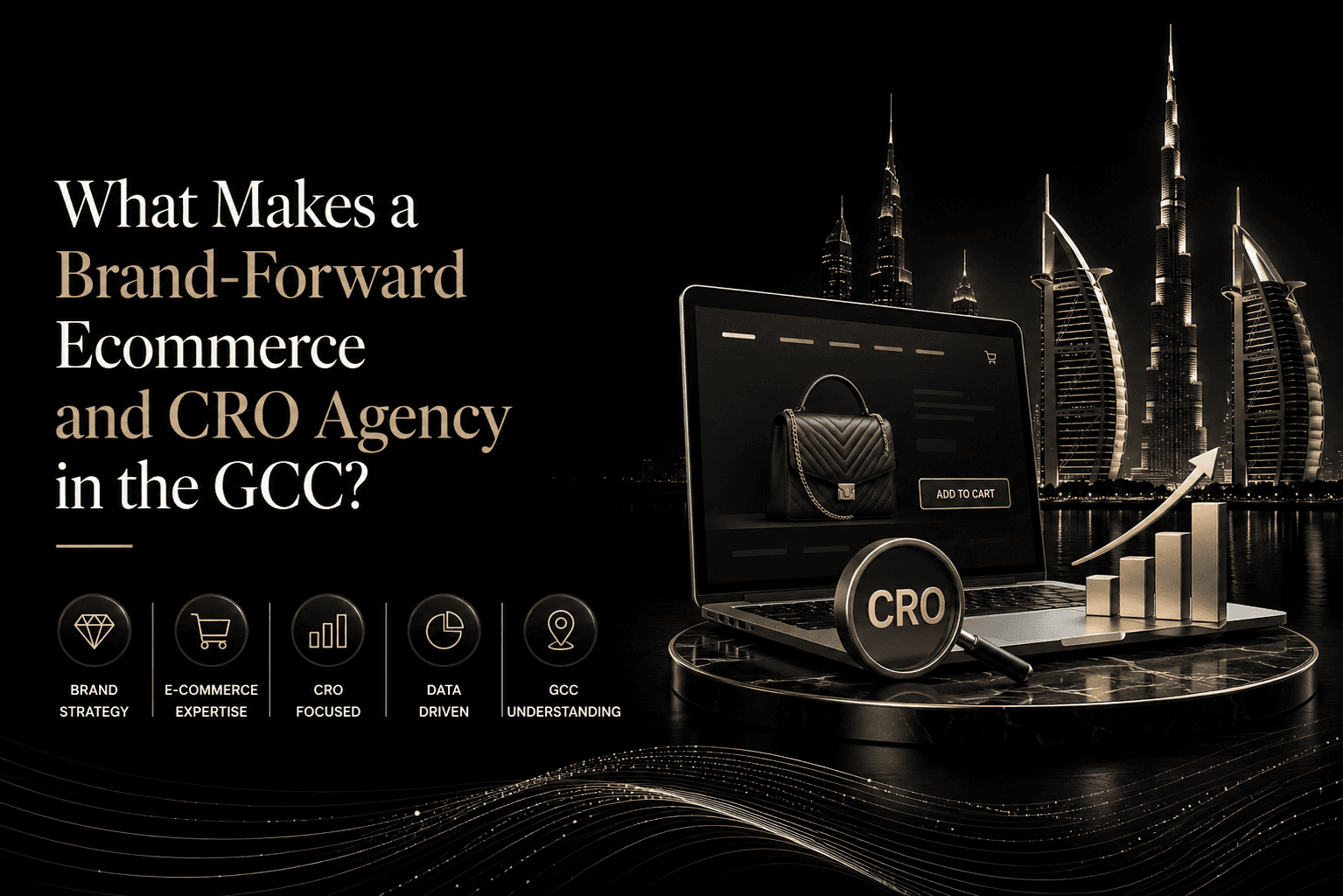
A brand-forward ecommerce agency in the GCC does more than build an attractive storefront or run isolated conversion tests. It protects the brand while improving the commercial performance of the entire customer journey.
The best partners connect brand strategy, ecommerce UX, conversion optimisation, technology, localisation, analytics and operations. For premium, fashion, beauty and luxury brands in markets such as the UAE and Saudi Arabia, that balance matters. A site can convert efficiently and still weaken the brand. It can also look exceptional while making it unnecessarily difficult to buy.
A brand-forward approach is designed to avoid both outcomes.
What does “brand-forward ecommerce” actually mean?
Brand-forward ecommerce treats brand and conversion as parts of the same commercial system. Instead of designing first and optimising later, the team translates brand positioning into navigation, merchandising, product discovery, content, checkout, retention and experimentation. Every conversion decision is evaluated against customer intent, brand equity and long-term revenue performance.
This is an important distinction.
Traditional ecommerce design often starts with visual identity. CRO programmes often start with funnel metrics. A brand-forward ecommerce and CRO agency starts with the relationship between the two.
A luxury fashion brand, for example, may deliberately use editorial imagery, restrained navigation and carefully paced storytelling. A pure CRO team might see unused screen space and fewer visible calls to action as problems. A pure design team might protect the aesthetic without asking whether customers can quickly understand sizing, availability, delivery or returns.
Neither extreme is enough.
Brand-led conversion optimisation asks a better question:
How can we make the buying journey easier without making the brand feel cheaper, louder or more generic?
Area | Design-first agency | CRO-only partner | Brand-forward ecommerce and CRO partner |
Brand | Primarily visual | Often treated as a constraint | Built into the commercial experience |
Conversion | Considered after design | Primary objective | Balanced with brand, margin and customer value |
UX | Focus on interface quality | Focus on friction reduction | Focus on intent, usability and brand perception |
Technology | Often handed to development | Usually secondary | Considered alongside UX and growth |
Localisation | Translation and basic adaptation | Market-dependent | Customer, cultural and operational localisation |
Measurement | Launch quality | Test uplift | Revenue, conversion, experience and scalability |
The third model is particularly relevant for brands looking for a premium ecommerce partner in the Middle East rather than another website supplier.
What should a brand-forward ecommerce and CRO agency do?
A strong agency should be able to diagnose the commercial journey, translate the brand into ecommerce behaviour, design high-performing mobile experiences, localise for GCC markets, implement technically feasible improvements and build a continuous measurement programme. It should also understand when not to optimise something simply because a short-term test suggests a higher click-through rate.
Six capabilities separate this type of partner from a conventional design or optimisation agency.
1. Translate the brand into customer decisions
Brand should influence much more than typography, photography and colour.
It should affect how products are presented, how categories are structured, what information appears first, how promotions are communicated, how much choice is shown and how customers move from discovery to purchase.
For premium and luxury brands, the product detail page is a good example.
A conversion-focused template might prioritise price, discount, urgency and an oversized purchase button. That may be appropriate for some retail categories. It can be completely wrong for a high-consideration luxury purchase.
A brand-forward team may instead need to balance:
Product storytelling, material and craftsmanship
Strong imagery and video without compromising performance
Clear size, fit, variant and availability information
Delivery, returns and service reassurance
Cross-selling that feels curated rather than algorithmically aggressive
A clear purchase path without visual clutter
Mobile interaction patterns suited to browsing and comparison
Regional content and fulfilment expectations
This is where an ecommerce UX strategy for fashion brands becomes different from applying a generic CRO playbook.
2. Treat CRO as a brand-led operating system
CRO should not mean changing button colours until one version wins.
The more valuable work usually begins earlier: identifying why customers hesitate, where commercial intent gets lost and which parts of the journey are underperforming.
That requires quantitative and qualitative evidence.
A mature programme might combine analytics, funnel analysis, session behaviour, customer-service themes, search data, usability testing, merchandising performance and controlled experimentation. The objective is to understand the problem before prescribing the interface.
Baymard’s 2025 checkout benchmark found that 64% of the desktop ecommerce sites and 63% of the mobile sites it assessed had “mediocre” or worse checkout UX. Its research highlights recurring problems such as difficult account creation, unclear delivery information and unnecessarily complex forms.
The lesson is not that every brand should copy a list of checkout best practices. It is that apparently small UX decisions can materially affect buying behaviour.
A brand-forward agency should therefore build a hierarchy of experiments.
Fix clear usability failures first. Test uncertain hypotheses second. Protect intentional brand decisions unless there is compelling evidence to reconsider them.
For teams developing this capability internally, a structured approach to UI, UX and CRO optimisation can help connect experience improvements to measurable commercial outcomes.
3. Design mobile commerce as the primary journey
For many ecommerce teams, “mobile-first” still means shrinking the desktop design.
That is not mobile strategy.
Small screens change how customers discover products, compare options, interact with filters, read product information, enter forms and evaluate trust. They also magnify unnecessary complexity.
Baymard’s mobile ecommerce research has documented thousands of usability issues across major ecommerce experiences, including problems across product discovery, mobile forms, carts, payment interfaces and checkout.
For a premium brand, the challenge is even sharper.
Rich editorial imagery and brand storytelling can improve desirability, but excessive media weight can slow down the journey. Minimal interfaces can feel sophisticated, but hidden navigation can reduce discoverability. Large imagery can create impact, but it can also push critical product information too far down the page.
A strong luxury ecommerce design agency in the GCC should know how to make those trade-offs deliberately.
The goal is not to make every site look like a high-volume marketplace. It is to preserve distinctiveness while removing friction that serves no brand purpose.
4. Localise the experience, not simply the language
Selling in the GCC is not one localisation task.
Saudi Arabia, the UAE, Kuwait, Qatar, Bahrain and Oman share regional characteristics, but customer expectations, fulfilment models, promotional calendars, operating structures and market priorities can differ.
Even within one storefront, localisation may affect:
Arabic and English content, right-to-left interface behaviour, currencies, pricing, delivery messaging, payment choices, returns communication, customer support, inventory availability, market-specific campaigns and merchandising.
This is why translation should happen inside a broader experience strategy.
A beautifully translated Arabic homepage does little if the product taxonomy is confusing, filters do not behave properly in right-to-left layouts, regional delivery information is buried, or the checkout introduces unexpected friction.
The same principle applies when a global brand enters Saudi Arabia using an experience originally designed around European or North American assumptions.
Regional adaptation should preserve the global brand system while removing local purchasing barriers.
Brands assessing their regional architecture can explore Autumn's approach to commerce transformation across the GCC.
5. Connect conversion to commerce operations
One of the clearest signs of a mature ecommerce agency is what happens when the problem is not on the page.
Imagine a product detail page with a weak conversion rate.
The immediate assumption might be poor design. But the real reason could be unreliable inventory visibility, unclear delivery dates, missing variant information, slow fulfilment, inconsistent promotions or customer uncertainty around returns.
A redesigned page cannot fix broken operational data.
This is why enterprise CRO increasingly overlaps with commerce transformation.
The agency should understand the relationship between the storefront and systems such as ERP, OMS, PIM, CRM, CDP, fulfilment, customer service and analytics platforms. It does not necessarily need to replace each system, but it should understand how those systems shape the experience customers see.
For enterprise teams, that changes the conversation from:
“Which landing page converts better?”
to:
“Which parts of our commerce ecosystem are stopping more customers from completing a profitable purchase?”
That is a much more useful question.
6. Understand what the platform can and cannot support
Good strategy still has to survive implementation.
A brand-forward agency needs enough platform and engineering depth to distinguish an ambitious idea from an unnecessarily fragile one.
Shopify is a useful example. Its current developer documentation states that checkout UI extensions for the information, shipping and payment stages are available to Shopify Plus merchants. Shopify also provides market-specific checkout overrides for eligible plans, allowing experiences and configurations to vary by market.
That matters when a design team proposes highly customised checkout behaviour for different GCC markets.
The right agency should understand whether the desired outcome can be achieved through native platform configuration, an extension, an app, custom development or a different architectural decision.
It should also know when customization creates unnecessary maintenance.
A premium experience should not require a fragile technology stack.
Why brand-forward CRO matters particularly for luxury and fashion ecommerce
Luxury and fashion businesses operate with a different conversion equation from many commodity retailers.
Brand perception affects willingness to pay. Merchandising affects both discovery and average order value. Photography can be part of product evaluation, not decoration. Size, fit, collection structure and availability strongly influence purchase confidence.
An aggressive conversion tactic can therefore produce misleading results.
A prominent discount may improve immediate conversion while weakening full-price demand. Excessive urgency can generate clicks while making a premium brand feel less credible. Aggressive cross-selling may increase basket interaction but interrupt a carefully designed purchasing journey.
This does not mean luxury brands should avoid CRO.
It means they need better CRO.
The agency should measure outcomes such as conversion rate, revenue per visitor, average order value, product discovery, margin, new versus returning customer behaviour and retention where the data allows it. It should also interpret those outcomes in the context of brand and merchandising strategy.
That is what separates brand-led conversion optimisation from funnel optimisation alone.
GCC commerce also has a trust and compliance layer
Customer experience decisions cannot be separated from the regulatory environment in which the brand operates.
Saudi Arabia's Personal Data Protection Law covers the processing of personal data and sets requirements around how organisations handle that data. The UAE also has a federal Personal Data Protection Law that establishes obligations around personal-data processing and privacy.
Saudi Arabia's Ministry of Commerce additionally maintains the country's E-Commerce Law, executive regulations, ecommerce compliance material and guidance for online stores.
For an ecommerce programme, this means analytics, personalisation, customer accounts, marketing consent, third-party tooling and data architecture should not be treated purely as design decisions.
Legal interpretation should remain with qualified counsel, but an agency working with enterprise brands should be able to identify where specialist compliance review is required.
How should you evaluate ecommerce and CRO agencies in Dubai or Riyadh?
Look beyond portfolios and headline conversion claims. Evaluate whether the agency can explain your brand, customer, commercial model, regional requirements, technical architecture and measurement framework as one connected system. The strongest partner should be equally comfortable discussing product discovery, design systems, experimentation, integrations, localisation and revenue performance.
When comparing top ecommerce CRO agencies in Dubai, Riyadh or elsewhere in the GCC, ask for evidence of how they think rather than simply what they have built.
A visually impressive portfolio proves design capability. It does not prove the team can diagnose conversion problems.
A list of A/B testing results proves experimentation experience. It does not prove the team understands premium brand positioning.
A long technology partner list does not prove the team can decide which technology your business actually needs.
The most useful evaluation is to give potential partners a real business problem and see how they deconstruct it.
For example:
“We have strong paid traffic and premium brand recognition, but mobile conversion in Saudi Arabia is below expectations. What would you investigate before redesigning the site?”
A strong answer should begin with diagnosis, not mock-ups.
It should consider traffic quality, device behaviour, page performance, merchandising, Arabic UX, product discovery, payment and delivery communication, checkout, analytics quality and operational constraints before recommending a solution.
What should the first engagement look like?
The first phase should create clarity before significant development begins.
A well-run engagement normally starts with commercial goals and customer behaviour, then moves into experience and technology.
The team should understand what the business is trying to change. Is the priority conversion, market expansion, premiumisation, retention, operational scalability, lower acquisition dependency, better merchandising or a full replatform?
From there, the agency can establish a baseline across analytics, UX, brand consistency, mobile behaviour, performance, platform architecture and regional requirements.
Only then should it build the roadmap.
This avoids the expensive pattern of redesigning an ecommerce storefront and discovering six months later that the biggest constraints were elsewhere.
For brands already generating meaningful traffic, the roadmap can then feed into an ongoing ecommerce growth optimisation programme rather than treating launch as the end of the work.
When is a brand-forward ecommerce agency not the right choice?
Not every ecommerce business needs this model.
An early-stage brand with very low traffic may not yet have enough behavioural data for a sophisticated experimentation programme. In that case, customer research, usability principles and fast commercial validation may matter more than continuous A/B testing.
A business selling heavily commoditised products may prioritise speed, availability and price over a distinctive brand journey.
A company with a strong internal design, engineering, CRO and analytics team may need specialist support in only one area instead of an integrated commerce partner.
There is also a budget trade-off.
Brand-forward commerce work requires collaboration across strategy, UX, engineering, data and growth. If the requirement is simply to launch a basic storefront as cheaply as possible, a full commerce transformation partner may be unnecessary.
The important thing is choosing the operating model that matches the problem.
Where Autumn fits
Autumn is an AI-first commerce transformation company.
It works with growth-stage and enterprise commerce brands to modernise digital commerce, improve revenue performance, build scalable commerce ecosystems and support expansion across GCC and global markets. Its broader positioning combines commerce transformation, revenue growth, customer experience, scalability and international expansion rather than treating ecommerce as a standalone website project.
For brands looking for a brand-forward ecommerce agency in the GCC, that means connecting the visible customer experience with the technology, data and operational systems underneath it.
The objective is not merely a more attractive website or a higher-converting page.
It is a commerce experience that can strengthen the brand, generate revenue and scale without creating a larger operational problem behind the scenes.
FAQs
What is a brand-forward ecommerce agency?
A brand-forward ecommerce agency treats the brand as part of the commercial system rather than a visual layer added to a storefront. It considers how positioning should influence navigation, merchandising, product pages, content, checkout, service and experimentation. The goal is to improve usability and conversion while protecting the distinctiveness that makes customers choose the brand in the first place.
What is the difference between a CRO agency and an ecommerce agency?
A CRO agency usually focuses on identifying and reducing conversion friction through analytics, research and experimentation. An ecommerce agency may cover design, development, platforms and integrations. A brand-forward ecommerce and CRO partner combines those disciplines. It can identify a conversion problem, understand its brand implications, design the solution and assess whether platform or operational changes are also required.
How do I choose an ecommerce CRO agency in Dubai or Riyadh?
Start with the business problem rather than location or platform badges. Look for a team that can explain how it will diagnose customer behaviour, mobile UX, merchandising, localisation, analytics and technical constraints before recommending changes. If GCC expansion is important, also assess the agency's experience with Arabic commerce experiences, regional operations and market-specific customer journeys.
Does a luxury ecommerce brand need CRO?
Yes, but luxury CRO should not blindly maximise clicks or short-term conversion. Premium brands need to consider how tests affect perceived value, merchandising, average order value and long-term customer behaviour. The strongest programmes remove unnecessary friction while preserving the storytelling, service and experience that justify premium positioning. In some cases, the highest-converting variation may not be the best commercial or brand decision.
What should an ecommerce UX strategy for fashion brands include?
It should cover product discovery, collection navigation, filtering, search, product imagery, size and fit information, variant selection, stock visibility, delivery and returns, mobile usability and checkout. Fashion brands should also examine how editorial storytelling connects to shopping behaviour. In GCC markets, Arabic UX, regional fulfilment expectations and market-specific merchandising may need to be included in the same strategy.
Should an ecommerce redesign happen before a CRO audit?
Usually not. A CRO and UX audit before redesign can reveal which parts of the existing experience genuinely need to change. Without that evidence, a brand may spend heavily rebuilding components that were already working while carrying the real conversion problems into the new site. The exception is when the existing technology or brand system is so outdated that a broader transformation is already unavoidable.
Build the next experience around evidence, not assumptions
If your brand is planning a redesign, replatform, GCC expansion or major conversion programme, the useful first step is not choosing a new homepage concept.
It is understanding where brand, UX, technology and commercial performance are currently misaligned.
A focused commerce and CRO audit can identify those gaps, prioritise the highest-value opportunities and show which improvements require design changes, experimentation, localisation or deeper commerce transformation before significant implementation begins.

Written by
Anand Vardhan
Founder
APAC's Leading Shopify Partner, now building across the GCC | AI-Led Commerce for DTC & Retail Brands | 1,000+ Builds

Free Consultation
Schedule a Strategy Briefing
Let’s create something amazing together! Reach out we'd love to hear about your project and ideas.
Explore other Categories
A brand-forward ecommerce agency in the GCC does more than build an attractive storefront or run isolated conversion tests. It protects the brand while improving the commercial performance of the entire customer journey.
The best partners connect brand strategy, ecommerce UX, conversion optimisation, technology, localisation, analytics and operations. For premium, fashion, beauty and luxury brands in markets such as the UAE and Saudi Arabia, that balance matters. A site can convert efficiently and still weaken the brand. It can also look exceptional while making it unnecessarily difficult to buy.
A brand-forward approach is designed to avoid both outcomes.
What does “brand-forward ecommerce” actually mean?
Brand-forward ecommerce treats brand and conversion as parts of the same commercial system. Instead of designing first and optimising later, the team translates brand positioning into navigation, merchandising, product discovery, content, checkout, retention and experimentation. Every conversion decision is evaluated against customer intent, brand equity and long-term revenue performance.
This is an important distinction.
Traditional ecommerce design often starts with visual identity. CRO programmes often start with funnel metrics. A brand-forward ecommerce and CRO agency starts with the relationship between the two.
A luxury fashion brand, for example, may deliberately use editorial imagery, restrained navigation and carefully paced storytelling. A pure CRO team might see unused screen space and fewer visible calls to action as problems. A pure design team might protect the aesthetic without asking whether customers can quickly understand sizing, availability, delivery or returns.
Neither extreme is enough.
Brand-led conversion optimisation asks a better question:
How can we make the buying journey easier without making the brand feel cheaper, louder or more generic?
Area | Design-first agency | CRO-only partner | Brand-forward ecommerce and CRO partner |
Brand | Primarily visual | Often treated as a constraint | Built into the commercial experience |
Conversion | Considered after design | Primary objective | Balanced with brand, margin and customer value |
UX | Focus on interface quality | Focus on friction reduction | Focus on intent, usability and brand perception |
Technology | Often handed to development | Usually secondary | Considered alongside UX and growth |
Localisation | Translation and basic adaptation | Market-dependent | Customer, cultural and operational localisation |
Measurement | Launch quality | Test uplift | Revenue, conversion, experience and scalability |
The third model is particularly relevant for brands looking for a premium ecommerce partner in the Middle East rather than another website supplier.
What should a brand-forward ecommerce and CRO agency do?
A strong agency should be able to diagnose the commercial journey, translate the brand into ecommerce behaviour, design high-performing mobile experiences, localise for GCC markets, implement technically feasible improvements and build a continuous measurement programme. It should also understand when not to optimise something simply because a short-term test suggests a higher click-through rate.
Six capabilities separate this type of partner from a conventional design or optimisation agency.
1. Translate the brand into customer decisions
Brand should influence much more than typography, photography and colour.
It should affect how products are presented, how categories are structured, what information appears first, how promotions are communicated, how much choice is shown and how customers move from discovery to purchase.
For premium and luxury brands, the product detail page is a good example.
A conversion-focused template might prioritise price, discount, urgency and an oversized purchase button. That may be appropriate for some retail categories. It can be completely wrong for a high-consideration luxury purchase.
A brand-forward team may instead need to balance:
Product storytelling, material and craftsmanship
Strong imagery and video without compromising performance
Clear size, fit, variant and availability information
Delivery, returns and service reassurance
Cross-selling that feels curated rather than algorithmically aggressive
A clear purchase path without visual clutter
Mobile interaction patterns suited to browsing and comparison
Regional content and fulfilment expectations
This is where an ecommerce UX strategy for fashion brands becomes different from applying a generic CRO playbook.
2. Treat CRO as a brand-led operating system
CRO should not mean changing button colours until one version wins.
The more valuable work usually begins earlier: identifying why customers hesitate, where commercial intent gets lost and which parts of the journey are underperforming.
That requires quantitative and qualitative evidence.
A mature programme might combine analytics, funnel analysis, session behaviour, customer-service themes, search data, usability testing, merchandising performance and controlled experimentation. The objective is to understand the problem before prescribing the interface.
Baymard’s 2025 checkout benchmark found that 64% of the desktop ecommerce sites and 63% of the mobile sites it assessed had “mediocre” or worse checkout UX. Its research highlights recurring problems such as difficult account creation, unclear delivery information and unnecessarily complex forms.
The lesson is not that every brand should copy a list of checkout best practices. It is that apparently small UX decisions can materially affect buying behaviour.
A brand-forward agency should therefore build a hierarchy of experiments.
Fix clear usability failures first. Test uncertain hypotheses second. Protect intentional brand decisions unless there is compelling evidence to reconsider them.
For teams developing this capability internally, a structured approach to UI, UX and CRO optimisation can help connect experience improvements to measurable commercial outcomes.
3. Design mobile commerce as the primary journey
For many ecommerce teams, “mobile-first” still means shrinking the desktop design.
That is not mobile strategy.
Small screens change how customers discover products, compare options, interact with filters, read product information, enter forms and evaluate trust. They also magnify unnecessary complexity.
Baymard’s mobile ecommerce research has documented thousands of usability issues across major ecommerce experiences, including problems across product discovery, mobile forms, carts, payment interfaces and checkout.
For a premium brand, the challenge is even sharper.
Rich editorial imagery and brand storytelling can improve desirability, but excessive media weight can slow down the journey. Minimal interfaces can feel sophisticated, but hidden navigation can reduce discoverability. Large imagery can create impact, but it can also push critical product information too far down the page.
A strong luxury ecommerce design agency in the GCC should know how to make those trade-offs deliberately.
The goal is not to make every site look like a high-volume marketplace. It is to preserve distinctiveness while removing friction that serves no brand purpose.
4. Localise the experience, not simply the language
Selling in the GCC is not one localisation task.
Saudi Arabia, the UAE, Kuwait, Qatar, Bahrain and Oman share regional characteristics, but customer expectations, fulfilment models, promotional calendars, operating structures and market priorities can differ.
Even within one storefront, localisation may affect:
Arabic and English content, right-to-left interface behaviour, currencies, pricing, delivery messaging, payment choices, returns communication, customer support, inventory availability, market-specific campaigns and merchandising.
This is why translation should happen inside a broader experience strategy.
A beautifully translated Arabic homepage does little if the product taxonomy is confusing, filters do not behave properly in right-to-left layouts, regional delivery information is buried, or the checkout introduces unexpected friction.
The same principle applies when a global brand enters Saudi Arabia using an experience originally designed around European or North American assumptions.
Regional adaptation should preserve the global brand system while removing local purchasing barriers.
Brands assessing their regional architecture can explore Autumn's approach to commerce transformation across the GCC.
5. Connect conversion to commerce operations
One of the clearest signs of a mature ecommerce agency is what happens when the problem is not on the page.
Imagine a product detail page with a weak conversion rate.
The immediate assumption might be poor design. But the real reason could be unreliable inventory visibility, unclear delivery dates, missing variant information, slow fulfilment, inconsistent promotions or customer uncertainty around returns.
A redesigned page cannot fix broken operational data.
This is why enterprise CRO increasingly overlaps with commerce transformation.
The agency should understand the relationship between the storefront and systems such as ERP, OMS, PIM, CRM, CDP, fulfilment, customer service and analytics platforms. It does not necessarily need to replace each system, but it should understand how those systems shape the experience customers see.
For enterprise teams, that changes the conversation from:
“Which landing page converts better?”
to:
“Which parts of our commerce ecosystem are stopping more customers from completing a profitable purchase?”
That is a much more useful question.
6. Understand what the platform can and cannot support
Good strategy still has to survive implementation.
A brand-forward agency needs enough platform and engineering depth to distinguish an ambitious idea from an unnecessarily fragile one.
Shopify is a useful example. Its current developer documentation states that checkout UI extensions for the information, shipping and payment stages are available to Shopify Plus merchants. Shopify also provides market-specific checkout overrides for eligible plans, allowing experiences and configurations to vary by market.
That matters when a design team proposes highly customised checkout behaviour for different GCC markets.
The right agency should understand whether the desired outcome can be achieved through native platform configuration, an extension, an app, custom development or a different architectural decision.
It should also know when customization creates unnecessary maintenance.
A premium experience should not require a fragile technology stack.
Why brand-forward CRO matters particularly for luxury and fashion ecommerce
Luxury and fashion businesses operate with a different conversion equation from many commodity retailers.
Brand perception affects willingness to pay. Merchandising affects both discovery and average order value. Photography can be part of product evaluation, not decoration. Size, fit, collection structure and availability strongly influence purchase confidence.
An aggressive conversion tactic can therefore produce misleading results.
A prominent discount may improve immediate conversion while weakening full-price demand. Excessive urgency can generate clicks while making a premium brand feel less credible. Aggressive cross-selling may increase basket interaction but interrupt a carefully designed purchasing journey.
This does not mean luxury brands should avoid CRO.
It means they need better CRO.
The agency should measure outcomes such as conversion rate, revenue per visitor, average order value, product discovery, margin, new versus returning customer behaviour and retention where the data allows it. It should also interpret those outcomes in the context of brand and merchandising strategy.
That is what separates brand-led conversion optimisation from funnel optimisation alone.
GCC commerce also has a trust and compliance layer
Customer experience decisions cannot be separated from the regulatory environment in which the brand operates.
Saudi Arabia's Personal Data Protection Law covers the processing of personal data and sets requirements around how organisations handle that data. The UAE also has a federal Personal Data Protection Law that establishes obligations around personal-data processing and privacy.
Saudi Arabia's Ministry of Commerce additionally maintains the country's E-Commerce Law, executive regulations, ecommerce compliance material and guidance for online stores.
For an ecommerce programme, this means analytics, personalisation, customer accounts, marketing consent, third-party tooling and data architecture should not be treated purely as design decisions.
Legal interpretation should remain with qualified counsel, but an agency working with enterprise brands should be able to identify where specialist compliance review is required.
How should you evaluate ecommerce and CRO agencies in Dubai or Riyadh?
Look beyond portfolios and headline conversion claims. Evaluate whether the agency can explain your brand, customer, commercial model, regional requirements, technical architecture and measurement framework as one connected system. The strongest partner should be equally comfortable discussing product discovery, design systems, experimentation, integrations, localisation and revenue performance.
When comparing top ecommerce CRO agencies in Dubai, Riyadh or elsewhere in the GCC, ask for evidence of how they think rather than simply what they have built.
A visually impressive portfolio proves design capability. It does not prove the team can diagnose conversion problems.
A list of A/B testing results proves experimentation experience. It does not prove the team understands premium brand positioning.
A long technology partner list does not prove the team can decide which technology your business actually needs.
The most useful evaluation is to give potential partners a real business problem and see how they deconstruct it.
For example:
“We have strong paid traffic and premium brand recognition, but mobile conversion in Saudi Arabia is below expectations. What would you investigate before redesigning the site?”
A strong answer should begin with diagnosis, not mock-ups.
It should consider traffic quality, device behaviour, page performance, merchandising, Arabic UX, product discovery, payment and delivery communication, checkout, analytics quality and operational constraints before recommending a solution.
What should the first engagement look like?
The first phase should create clarity before significant development begins.
A well-run engagement normally starts with commercial goals and customer behaviour, then moves into experience and technology.
The team should understand what the business is trying to change. Is the priority conversion, market expansion, premiumisation, retention, operational scalability, lower acquisition dependency, better merchandising or a full replatform?
From there, the agency can establish a baseline across analytics, UX, brand consistency, mobile behaviour, performance, platform architecture and regional requirements.
Only then should it build the roadmap.
This avoids the expensive pattern of redesigning an ecommerce storefront and discovering six months later that the biggest constraints were elsewhere.
For brands already generating meaningful traffic, the roadmap can then feed into an ongoing ecommerce growth optimisation programme rather than treating launch as the end of the work.
When is a brand-forward ecommerce agency not the right choice?
Not every ecommerce business needs this model.
An early-stage brand with very low traffic may not yet have enough behavioural data for a sophisticated experimentation programme. In that case, customer research, usability principles and fast commercial validation may matter more than continuous A/B testing.
A business selling heavily commoditised products may prioritise speed, availability and price over a distinctive brand journey.
A company with a strong internal design, engineering, CRO and analytics team may need specialist support in only one area instead of an integrated commerce partner.
There is also a budget trade-off.
Brand-forward commerce work requires collaboration across strategy, UX, engineering, data and growth. If the requirement is simply to launch a basic storefront as cheaply as possible, a full commerce transformation partner may be unnecessary.
The important thing is choosing the operating model that matches the problem.
Where Autumn fits
Autumn is an AI-first commerce transformation company.
It works with growth-stage and enterprise commerce brands to modernise digital commerce, improve revenue performance, build scalable commerce ecosystems and support expansion across GCC and global markets. Its broader positioning combines commerce transformation, revenue growth, customer experience, scalability and international expansion rather than treating ecommerce as a standalone website project.
For brands looking for a brand-forward ecommerce agency in the GCC, that means connecting the visible customer experience with the technology, data and operational systems underneath it.
The objective is not merely a more attractive website or a higher-converting page.
It is a commerce experience that can strengthen the brand, generate revenue and scale without creating a larger operational problem behind the scenes.
FAQs
What is a brand-forward ecommerce agency?
A brand-forward ecommerce agency treats the brand as part of the commercial system rather than a visual layer added to a storefront. It considers how positioning should influence navigation, merchandising, product pages, content, checkout, service and experimentation. The goal is to improve usability and conversion while protecting the distinctiveness that makes customers choose the brand in the first place.
What is the difference between a CRO agency and an ecommerce agency?
A CRO agency usually focuses on identifying and reducing conversion friction through analytics, research and experimentation. An ecommerce agency may cover design, development, platforms and integrations. A brand-forward ecommerce and CRO partner combines those disciplines. It can identify a conversion problem, understand its brand implications, design the solution and assess whether platform or operational changes are also required.
How do I choose an ecommerce CRO agency in Dubai or Riyadh?
Start with the business problem rather than location or platform badges. Look for a team that can explain how it will diagnose customer behaviour, mobile UX, merchandising, localisation, analytics and technical constraints before recommending changes. If GCC expansion is important, also assess the agency's experience with Arabic commerce experiences, regional operations and market-specific customer journeys.
Does a luxury ecommerce brand need CRO?
Yes, but luxury CRO should not blindly maximise clicks or short-term conversion. Premium brands need to consider how tests affect perceived value, merchandising, average order value and long-term customer behaviour. The strongest programmes remove unnecessary friction while preserving the storytelling, service and experience that justify premium positioning. In some cases, the highest-converting variation may not be the best commercial or brand decision.
What should an ecommerce UX strategy for fashion brands include?
It should cover product discovery, collection navigation, filtering, search, product imagery, size and fit information, variant selection, stock visibility, delivery and returns, mobile usability and checkout. Fashion brands should also examine how editorial storytelling connects to shopping behaviour. In GCC markets, Arabic UX, regional fulfilment expectations and market-specific merchandising may need to be included in the same strategy.
Should an ecommerce redesign happen before a CRO audit?
Usually not. A CRO and UX audit before redesign can reveal which parts of the existing experience genuinely need to change. Without that evidence, a brand may spend heavily rebuilding components that were already working while carrying the real conversion problems into the new site. The exception is when the existing technology or brand system is so outdated that a broader transformation is already unavoidable.
Build the next experience around evidence, not assumptions
If your brand is planning a redesign, replatform, GCC expansion or major conversion programme, the useful first step is not choosing a new homepage concept.
It is understanding where brand, UX, technology and commercial performance are currently misaligned.
A focused commerce and CRO audit can identify those gaps, prioritise the highest-value opportunities and show which improvements require design changes, experimentation, localisation or deeper commerce transformation before significant implementation begins.
Written by
Anand Vardhan
Founder
APAC's Leading Shopify Partner, now building across the GCC | AI-Led Commerce for DTC & Retail Brands | 1,000+ Builds
Free Consultation
Schedule a Strategy Briefing
Let’s create something amazing together! Reach out we'd love to hear about your project and ideas.
Explore other Categories